🔭 NASA Telescope Spots a Young Sun-Like Star Inflating Its Astrosphere
In a breakthrough discovery, astronomers using NASA’s powerful space telescope have captured the first clear image of a young Sun-like star creating a massive bubble of charged particles around itself — a structure known as an astrosphere.
The discovery was made using the Chandra X-ray Observatory, which observed the young star HD 61005, located about 120 light-years from Earth.
⭐ Meet HD 61005 – A Young Version of Our Sun
HD 61005 is remarkably similar to our Sun in size and temperature — but much younger.
Age: Around 100 million years old
Comparison: Our Sun is about 4.6 billion years old
Distance: ~120 light-years away
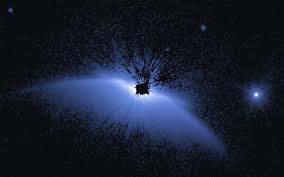
Because of its youth, HD 61005 is far more active than our Sun is today. Young stars tend to produce stronger stellar winds — streams of charged particles flowing outward into space.
🌌 What Is an Astrosphere?
An astrosphere is essentially a protective bubble formed when a star’s stellar wind pushes against surrounding interstellar gas.
Our own Sun has a similar structure called the heliosphere, which shields our solar system from harmful cosmic radiation. However, we can’t see the heliosphere clearly from the outside — so observing HD 61005 gives scientists a rare external look at what our early Sun’s bubble may have looked like billions of years ago.
💨 A Bubble Much Stronger Than Our Sun’s
Scientists discovered that HD 61005’s stellar wind is:
About three times faster than the Sun’s current wind
Roughly 25 times denser
This powerful wind inflates a large, X-ray-emitting bubble that Chandra was able to detect. The strong emission makes this one of the clearest images ever captured of an astrosphere around a Sun-like star.
🦋 Why Is It Called “The Moth”?
HD 61005 has earned the nickname “The Moth” due to its wing-shaped dusty structure visible in infrared observations. The shape likely results from interactions between the star’s disk of debris and surrounding interstellar material.
🚀 Why This Discovery Matters
This discovery is significant for several reasons:
1️⃣ A Glimpse Into the Sun’s Past
Studying HD 61005 helps scientists understand what our Sun may have looked like during its early years — when the solar system was still forming.
2️⃣ Planetary Protection Insights
Astrospheres act as shields against cosmic radiation. Understanding how these protective bubbles evolve helps researchers evaluate how young planetary systems might develop — and how well they’re protected.
3️⃣ Stellar Wind Evolution
The finding provides valuable data on how stellar winds change over time, offering new clues about star life cycles.
🔬 A Window Into Cosmic History
Because we cannot observe our own heliosphere from outside the solar system, HD 61005 offers something extraordinary: a cosmic mirror. It allows scientists to see a Sun-like star in its energetic youth, blowing a massive protective bubble into space.
This discovery doesn’t just expand our understanding of stars — it deepens our understanding of our own origins.
🌠 Final Thoughts
The observation of HD 61005’s expanding astrosphere marks an important milestone in stellar astronomy. With advanced space telescopes like NASA’s Chandra X-ray Observatory, we are now able to witness phenomena that were once only theoretical.
As researchers continue studying young stars like HD 61005, we move closer to answering some of the biggest questions about how solar systems form — and how life-supporting environments may emerge across the universe.